I'm looking forward to this year at Brock University for a few reasons. One of them is to be taught by a good professor. I get the 'religious status' of every professor I have. Most start off with a quote from Nietzsche and it's easy enough to figure them out. But I've had a few great exceptions.
One prof I had was Leonard Ferry, I don't know if I'm allowed to mention him on this blog - I doubt he'll ever read it - but through the course of the year I learned a great deal from him. He taught us "Ancient Political Philosophy" which was code for "Aristotelian Moral and Social Philosophy". He challenged all of our (myself included) modernist assumptions about ethics, he taught us from a Natural Law perspective (something I'd never encountered before Catholicism) and when I heard him quote Aquinas I got suspicious. Normally they don't let conservatives of any kind into liberal public universities, but Ferry had snuck in it seemed.
The problem was I had been beaten down by secularism at university. He was another philosophy professor, and I assumed a Nietzschean. So when we discussed the Republic, I used my modernist (or post-modernist) criticisms in the hope of scoring brownie points. He rebutted everything I said with Thomistic philosophy, and I knew then, that this was the smartest non-atheistic (I didn't know he was Catholic yet) philosopher I'd ever met. I soon learned through the grapevine (Mel) that he was indeed a Romanist. His teachings on Aristotle (and by continuation - smuggled in Aquinas/Christianized Aristotle) mixed with the scholastic epistemology I had learned from my Grade 12 philosophy prof made it so that I was ripe for conversion to Rome.
This good professor made us read 2 works of Aristotle (Nicomachean Ethics, and The Politics) and I read both in a course of a few days. Aristotle hit me like a ton of bricks, he was a genius, and (best of all) he could prove the existence and value of virtues without resorting to God. I could use reason alone to prove the natural law.
I remember how much this changed my life when I was at a "Focus on the Family" event at my parents Baptist church, before I had entered the Catholic Communion. It was called "The Truth Project" and was basically teaching presuppositional apologetics - apologetics that take for granted that God exists, and that the Bible is true. As everyone looked around the room satisfied with the state of things I was trying to stop myself from laughing. "If someone believes God exists and that the Bible is true, aren't they already a Christian? and isn't the only purpose of apologetics, conversion?" No one got it. We were on different frameworks. They were on divine command ethics, I was in virtue ethics. They had "Answers in Genesis" to 'prove' God, I had the Summa and St. Thomas' Five ways (and at that point Descartes).
Speaking of Descartes, Dr. Ferry also ripped apart all my Cartesian theism which had got me through 1st year, and after the course was done and I'd read through G.K. Chesterton's "Orthodoxy" I had safely executed the Cogito, as well as a completely uncritical acceptance of Reason alone.
Aquinas, Scotus, and other scholastics always warned about a trust in reason alone, something the Reformers reacted to, but that's another issue. Anyway, that is how I got a Thomistic (Or possibly just Catholic) basis for what I believed.
I've found Aristotelian Thomism to be the most ingenius thing. Although my catechesis has made me pretty Molinist (Catholicism is obsessed with foreknowledge...), I'm really hoping to figure out some more Thomism, and hopefully read some Etienne Gilson and Jacques Maritain.
Professor Ferry also taught me that those Thomistic philosophers helped pioneer the UN Declaration on Human Rights. pretty cool.
Showing posts with label G.K. Chesterton. Show all posts
Showing posts with label G.K. Chesterton. Show all posts
Monday, August 10, 2009

Tuesday, January 6, 2009
Goodbye Nietzsche
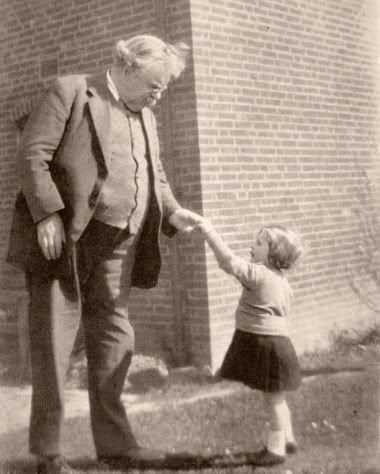 The above pictured man is the kind hearted, G.K. Chesterton, Genius Extraordinaire, Defender of Christian Orthodoxy.
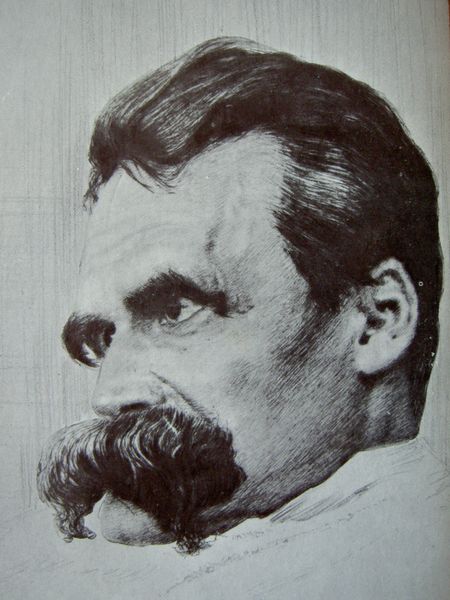 This is the super-fucked up Friedrich Nietzsche - The Hero of the Nazis, and all around Douchebag, scum of the earth.
I was reading "Orthodoxy" by G.K. Chesterton today and it is AMAZING. He completely refutes the ideas of Nietzsche. I only wish someone would've told me about him sooner. I've been trying to come up with these arguments myself because I didn't think anyone else out-thought him in print at least. Wow, good freakin job G.K.
"Nietzsche, whom some are representing as a bold and strong thinker. No one will deny that he was a poetical and suggestive thinker; but he was quite the reverse of strong. He was not at all bold. He never put his own meaning before himself in bald abstract words: as did Aristotle and Calvin, and even Karl Marx, the hard, fearless men of thought. Nietzsche always escaped a question by a physical metaphor, like a cheery minor poet. He said, “beyond good and evil,” because he had not the courage to say, “more good than good and evil,” or, “more evil than good and evil.” Had he faced his thought without metaphors, he would have seen that it was nonsense. So, when he describes his hero, he does not dare to say, “the purer man,” or “the happier man,” or “the sadder man,” for all these are ideas; and ideas are alarming. He says “the upper man,” or “over man,” a physical metaphor from acrobats or alpine climbers. Nietzsche is truly a very timid thinker. He does not really know in the least what sort of man he wants evolution to produce. And if he does not know, certainly the ordinary evolutionists, who talk about things being “higher,” do not know either." - Chesterton in Orthodoxy
He is destroying Nietzsche's claim that he is himself beyond this Christian view of good and evil, when Nietzche is really only establishing his own system of good and evil which he likes more. Every value he advances has no inherent value. Lust, violence, and the will to power are Nietzsche's ideal characteristics. But Why? Nietzsche isn't offering us anything new about humanity he's just trying to shock us. Amen Chesterton. Did I mention Chesterton was a Catholic? Booyah!
"Nietzsche, whom some are representing as a bold and strong thinker. No one will deny that he was a poetical and suggestive thinker; but he was quite the reverse of strong. He was not at all bold. He never put his own meaning before himself in bald abstract words: as did Aristotle and Calvin, and even Karl Marx, the hard, fearless men of thought. Nietzsche always escaped a question by a physical metaphor, like a cheery minor poet. He said, “beyond good and evil,” because he had not the courage to say, “more good than good and evil,” or, “more evil than good and evil.” Had he faced his thought without metaphors, he would have seen that it was nonsense. So, when he describes his hero, he does not dare to say, “the purer man,” or “the happier man,” or “the sadder man,” for all these are ideas; and ideas are alarming. He says “the upper man,” or “over man,” a physical metaphor from acrobats or alpine climbers. Nietzsche is truly a very timid thinker. He does not really know in the least what sort of man he wants evolution to produce. And if he does not know, certainly the ordinary evolutionists, who talk about things being “higher,” do not know either." - Chesterton in Orthodoxy
He is destroying Nietzsche's claim that he is himself beyond this Christian view of good and evil, when Nietzche is really only establishing his own system of good and evil which he likes more. Every value he advances has no inherent value. Lust, violence, and the will to power are Nietzsche's ideal characteristics. But Why? Nietzsche isn't offering us anything new about humanity he's just trying to shock us. Amen Chesterton. Did I mention Chesterton was a Catholic? Booyah!
Subscribe to:
Posts (Atom)


